Identifying Types of Deer

Male White-Tailed Deer

Female White-Tailed Deer

White-Tailed Deer
Reddish-brown to blue-gray or tan coloring; underside of tail is white, producing a “flag” when raised off the rump. Antlers on the male primarily consist of a main beam with tines growing from it. Maximum antler size occurs between 5–7 years of age.
Habitat and Habits
Range movements limited to one to three miles depending on sex, age, and habitat. Herbivore. Lives up to 10 years. Male is polygamous, with most whitetails in North America rutting in November. One to two spotted fawns is typical.
How to Distinguish Adult White-Tailed Deer From Fawns*
Fawns
- Short, square bodies (look like a briefcase from a distance)
- Short necks and less muscle development
- Rarely have swaying backs or sagging bellies
- Ears appear large in comparison to head
Adults
- Larger, rectangular-shaped bodies (look like a suitcase from a distance)
- Long necks

How to Identify Buck Fawns*
- Presence of developing antlers
- Head appears more flat and less rounded between ears
How to Identify Doe Fawns*
- No developing antlers
- Head appears slightly rounded between ears
* Courtesy of the National Deer Association


Mule Deer
Reddish coloring in summer and blue-gray in winter. Cream-colored rump patch with black-tipped cream tail. Ears are larger than the white-tailed deer's. Antlers branch equally.
Habitat and Habits
Lives in forests, desert shrubs, thickets of shrubs, trees, grasslands, plains, foothills, and river bottoms. Herbivore. Lives up to 16 years. Male is polygamous; rut runs Oct.–Dec. One to two spotted fawns is typical.

Male Mule Deer

Female Mule Deer

Sitka Black-tailed Deer
The Sitka black-tailed deer (Odocoileus hemionus sitkensis) is smaller, stockier, and has a shorter face than other deer species. The summer coat of reddish-brown is replaced by dark brownish-gray in winter. A Sitka black-tailed buck’s antlers are dark brown. Normal adult antler development is three points on each side.
Habitat and Habits
Lives in wet coastal rainforests in Southeast Alaska. Because they swim well, they can be found on various islands (Prince William Sound, Kodiak, and Afognak islands). During winter, the distribution of deer at various elevations is influenced by changing snow depth. During extreme snow accumulation, many deer congregate in heavily timbered stands at lower elevations, and some may even move on to the beach.
Deer populations in Alaska are dynamic and fluctuate considerably with the severity of winters. Mild winters generally allow for an increase in the population, but a particularly harsh winter typically spells decline for the population. The deer’s high reproductive potential helps depressed populations to recover rapidly.
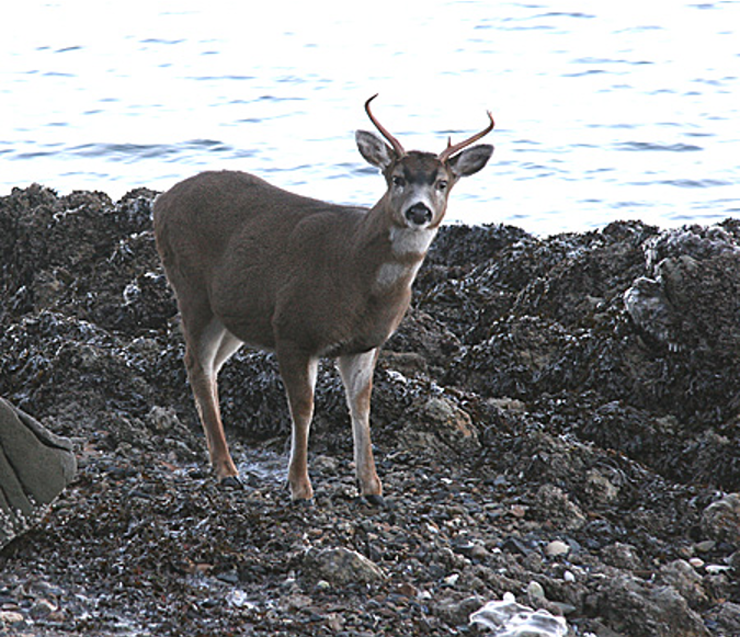
Male Black-Tailed Deer
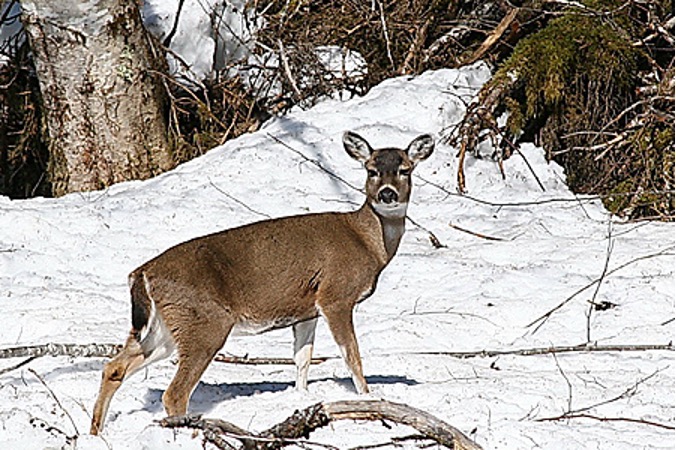
Female Black-Tailed Deer
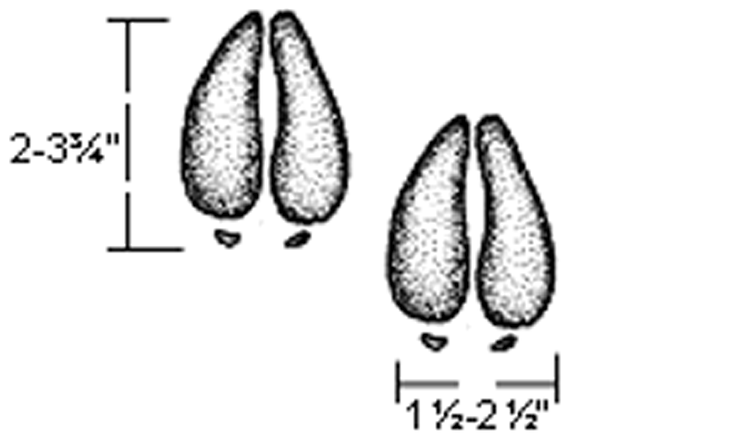
Antlers vs. Horns
Members of the deer family (which includes caribou, deer, elk, and moose) have antlers. Antlers are solid bone and are shed annually. They are one of the fastest growing natural materials in the world. Antlers grow from the tip while horns grow from the base. Except for caribou, only male deer have antlers.
Horns are found on bison, sheep, goats, and pronghorns. Unlike antlers, true horns are hollow and grow continuously. If broken, they do not grow back. They consist of a keratin sheath surrounding a core of bone. Female sheep have half-moon horns while rams have horns that are longer and heavier and curve around the sides of their heads. Female mountain goats have horns that are longer, straighter, and thinner than male goats. The horn sheath of a pronghorn has characteristics of both antlers and bones because it’s made of keratin, which surrounds the bony core, yet it is shed annually.